Cornavin station guide
History of Geneva Cornavin Station
The station is named after a place that no longer exists: a gate cut into Geneva’s fortifications, the only way into the city from the right bank. Here is where the name comes from, why the station was built exactly there, and what you can still see today.
The gate before the station
Before it was a station, Cornavin was a crossing point. The name first belonged to a nant — a stream — then to a bastion, then to the Porte de Cornavin: the single entrance into Geneva from the right bank, set in the ring of fortifications that enclosed the city.
That gate was no small thing. Everything arriving from the north — goods, travellers, mail — had to pass through it, stop there, and pay what was due. A suburb grew up outside the walls, with its inns and its warehouses.
When the fortifications came down in the 19th century, the name outlived what it described. It passed to the street, then to the square, then to the station. That is the short answer to “why Cornavin”: the station was built outside the walls, directly in front of the Porte de Cornavin, and inherited its name.
Four theories for one name
The origin of the word itself is unsettled. The name is old, and four readings coexist without any consensus among historians.
| Theory | What supports it |
|---|---|
| The bishop’s vineyards | The most cited. The land belonged to the Bishop of Geneva and, from the 11th to the 15th century, vineyards covered the ground between Coutance and the lake — precisely today’s location. |
| “Corne”, a duty on wine | A tax levied on wine entering the city. The name would mark the collection point, at the entrance. |
| “Corne”, a corner | “Corne” in the sense of angle: the square formed a pointed plot of land between the old bastions. |
| The inn “La Corne à Vin” | A tavern said to have given the district its name. Appealing, but poorly supported by historians. |
Three of the four point to wine, which is no accident in a suburb of vineyards and tolls. But on the available evidence, nobody can say which one is right. Be wary of pages that give only one, without reservation.
1849: Geneva tears down its walls
None of this would have happened without a political decision. On 15 September 1849, the Grand Council ruled that the fortifications enclosing Geneva would be demolished. Militarily obsolete, they were strangling a city that could no longer grow. Demolition began in 1850.
On the freed land, engineer Léopold Blotnitzki drew up the general expansion plan for the Department of Public Works — adopted by the Council of State in 1855 and again in 1858. The plan tripled the city’s area: a ring of new districts, 6,500 dwellings, schools, churches, boulevards and quays.
One detail matters here: the plan explicitly provided for the new city’s public facilities — and the station was one of them. Cornavin is therefore not a building dropped at random beside an old rampart. It is a component of an urban project that replaced a military belt with a civic one.
1858: why here, and not elsewhere
The location of the main station was nonetheless disputed. Three other sites were on the table: Bel-Air, l’Île and la Coulouvrenière — all closer to the centre. It was the banker François Bartholoni who imposed Cornavin, on the cleared ground in front of the former gate.
The choice is still debated today. It placed the station away from the historic core, on the right bank, and concentrated all traffic from the north onto a single point — a constraint the city has never really resolved since.
Construction began in 1854. The opening ran over three days, 16 to 18 March 1858. Thirty years later the left bank would get its own station at the Eaux-Vives, in 1888 — two stations with no link between them, which would weigh heavily later on.
One detail is often forgotten: the station did not belong to Switzerland at the time. It remained the private property of the French PLM company until 1912.
The fire of 11 February 1909
On 11 February 1909, a fire broke out in the hand-luggage left-luggage office, caused by an overheating stove. The building was almost entirely destroyed: only the stone walls remained.
The 1858 station thus lasted fifty-one years. What Geneva built next was not a repair but a building of another ambition altogether.
Flegenheimer’s station
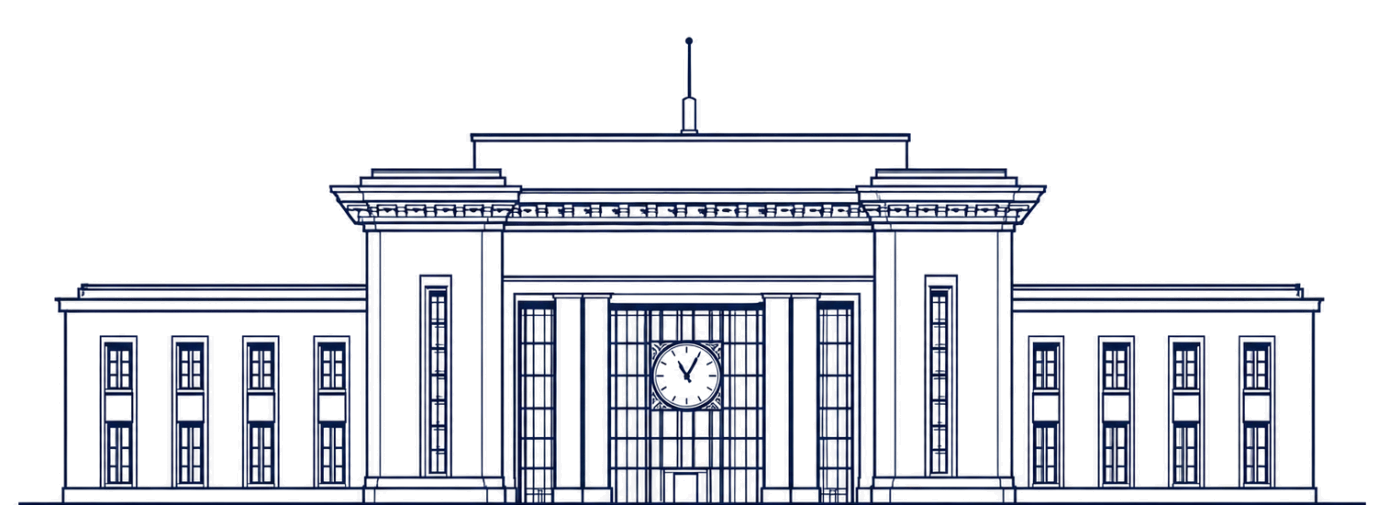
Reconstruction was entrusted to architect Julien Flegenheimer, with sculptures by Jacques Probst. The new central hall was inaugurated on 25 June 1929 and the whole project was completed in 1931.
This is the building you walk through today. Geneva did not merely rebuild its station: it made it an international station, on the scale of a city that had become the seat of the League of Nations a few years earlier.
From steam to the Léman Express
- 1 February 1925 — the Lausanne–Geneva line is electrified at 15 kV AC, 16.7 Hz.
- 1956 — the Geneva–La Plaine line is electrified at 1.5 kV DC, to meet the French network.
- 2014 — that same line is converted to 25 kV AC, aligned with the Swiss standard.
- 15 December 2019 — the Léman Express enters service.
- November 2024 — a new computerised interlocking centre is activated.
CEVA: 107 years between the idea and the train
Connecting Cornavin to the left bank and to France is not a recent idea. On 7 May 1912, a convention between the Confederation, the Canton of Geneva and the SBB set the financing of the Cornavin–Eaux-Vives–Annemasse link: one third each. That is the founding act of CEVA — and, as it happens, the same year the station ceased to be PLM property.
Preliminary studies ran from 1912 to 1938. Then economic crises, wars and political deadlock pushed the project back, decade after decade. The first train ran on 15 December 2019.
107 years separate the signature from the opening. It is what finally joined the two stations Geneva had given itself in 1858 and 1888.
The underground station: what is actually decided
Cornavin is saturated. 171,000 people pass through every day — travellers, people crossing, customers of the shops. The SBB’s answer is an underground extension, part of the Léman 2030 programme.
Figures circulate widely and are often wrong. These come from the SBB themselves:
- Budget: around 2 billion francs
- Public consultation: end of 2027 at the earliest
- Start of works: 2030 at the earliest, depending on how long the procedure takes
- Duration: roughly nine years
- Target opening: around 2038
In short: nothing changes inside the station for several years yet. And if the CEVA story teaches anything, it is that a Geneva railway timetable should be read with caution.
What you can still see
The Porte de Cornavin vanished with the fortifications, and nothing of it survives on site. The line of the ramparts, however, can still be read in the layout of the boulevards that came out of the Blotnitzki plan.
The visible witness is the 1929 hall and the sculptures by Jacques Probst. The rest lives in the name: a vanished gate, four theories about a word, and 171,000 people crossing the old northern entrance to Geneva every day without knowing it.
Frequently asked questions
Why is Geneva’s station called Cornavin?
Because it was built outside the walls, directly in front of the Porte de Cornavin — the only entrance into Geneva from the right bank. The fortifications were demolished from 1850 onwards, but the name remained and passed to the street, the square, and then the station, which opened in 1858.
What does the word “Cornavin” mean?
The origin is not established. Four theories coexist: the vineyards of the Bishop of Geneva that covered the site from the 11th to the 15th century (the most cited), a wine duty called “corne”, the word “corne” meaning a corner for a pointed plot between bastions, or an inn named “La Corne à Vin”. None commands consensus.
When was Cornavin station built?
Construction began in 1854 and the station opened from 16 to 18 March 1858. It remained the private property of the French PLM company until 1912.
Why was the station rebuilt in 1929?
A fire that started from a stove in the hand-luggage office destroyed the 1858 building on 11 February 1909, leaving only the stone walls. Reconstruction by architect Julien Flegenheimer produced the hall inaugurated on 25 June 1929 and completed in 1931 — the one you walk through today.
When will the Cornavin underground station open?
The SBB are targeting around 2038. Public consultation is expected at the end of 2027 at the earliest, with works starting in 2030 at the earliest and lasting roughly nine years, budgeted at some 2 billion francs.
Why did the Léman Express take so long?
The financing convention for the Cornavin–Eaux-Vives–Annemasse link was signed on 7 May 1912. Studies ran from 1912 to 1938, then economic crises, wars and political deadlock pushed the project back. The first train ran on 15 December 2019, 107 years after the signature.